Abstract
Submissions
Now Open
Share your HIV research with Cameroon’s leading forum for operational research and implementation science. Present to policymakers, connect with researchers, and contribute to national HIV strategy.
Submit Now
Deadline: January 30th, 2026
Under the coordination of the Division of Operational Research of the Ministry of Health
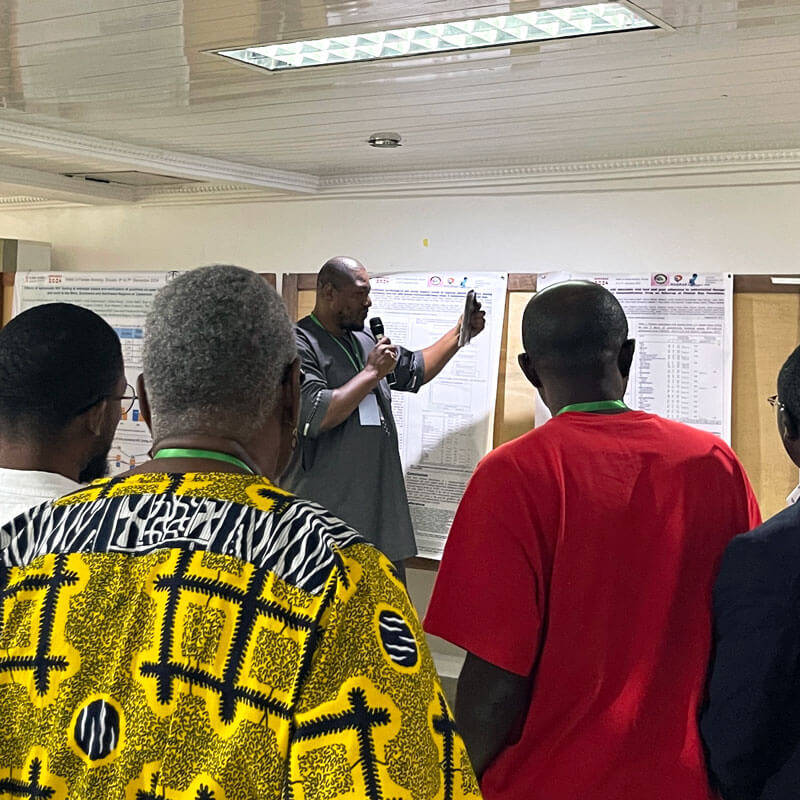
The Cameroon HIV/AIDS Research Forum (CAM-HERO) is inviting HIV/AIDS researchers to submit abstracts for the fifth CAM-HERO conference. The conference will be held in Douala on the 19th and 20th January 2026.
We welcome abstracts in all areas of HIV/AIDS research:
Basic Science
Virology, immunology, diagnostics, and biomarkers
Clinical Science
Treatment, monitoring, drug resistance, and clinical outcomes
Prevention Science
Testing strategies, PrEP, PMTCT, and behavioral interventions
Implementation Science
Health systems, policy, and program evaluation
Submission Process
Follow the following steps to submit your abstracts online.
.01
REGISTER
Create your account at cam-hero.org (or login if you already have one)
.02
REVIEW GUIDELINES
Read the submission requirements and choose your abstract format (Research Study or Program Lessons)
.03
SUBMIT ONLINE
Complete the online submission form Upload graphics/tables if needed (max 2 each)
.04
CONFIRMATION
Check your email for confirmation (including spam folder)
Before you submit
Please read these guidelines carefully. You’ll receive a confirmation email upon submission—check your spam folder if you don’t see it within 30 minutes.
⚠️ Do not resubmit! Contact camhero2021@gmail.com if you don’t receive confirmation.
Submission Guidelines
Length & Format
- The text should not exceed 300 words (excluding abstract title and authors)
- Add a maximum of 3 keywords
- Title should be typed in capitals bold and should not exceed more than 100 characters; titles with more than 100 characters will be truncated
How to Submit
- All abstracts must be submitted via cam-hero.org
- First register then submit your abstract. But if you already have an account, just login and update your profile
- Abstracts sent by fax, post or email will not be accepted
- A confirmation of receipt will be sent via email upon submission of an abstract
Attachments
- A maximum of 2 graphics and 2 tables can be uploaded as an attachment upon submission
- These will not add to the word count
Abstract Text Requirements
- The text of the abstract should briefly state: [Background, Methods, Results, Conclusions OR Background, Description, Lessons Learned, Next Steps]
- All abbreviations must be defined in brackets during the first utilisation, before being used in the text
- Avoid formulas
- For drugs, use only the scientific name
- Do not include references, research grants or stock options
- No endnotes or frames are acceptable
Editing & Responsibility
- Modifications can be made until the abstract submission deadline
- It is the author’s responsibility to submit a correct abstract
- Any errors in spelling, grammar or scientific fact will be reproduced as submitted by the author
Abstract Structure
Use one of these two formats to structure your abstract.

Research Studies
This format is applicable to research across various disciplines. Abstracts following Option 1 should include brief statements on:
Background: State the research’s purpose, objectives, hypothesis, or problem being analyzed or evaluated.
Methods: Outline the study’s duration, setting, design, population, data collection methods, and analysis techniques.
Results: Clearly and thoroughly present the study’s findings or outcomes. Summarize key results.
Conclusions: Discuss the significance of the findings for HIV prevention, treatment, care, or support, and highlight the future implications.

Program, Project, or Policy Lessons Learned
This format is suitable for abstracts derived from program, project, or policy implementation and management. Abstracts under Option 2 should include:
Background: Provide an overview of the program, project, or policy’s purpose, scope, and objectives.
Description: Detail the program, project, or policy’s duration, setting, location, structure, and the activities and interventions undertaken.
Lessons Learned: Present detailed findings or outcomes, including an analysis of lessons learned and best practices. Summarize specific results that support these lessons and practices.
Conclusions/Next Steps: Explain the significance of the findings for HIV prevention, treatment, care, or support, and discuss the future implications.